What Does Labor Feel Like? My Fertility Blog

What Does Labor Feel Like? My Fertility Blog

Pregnancy is a wonderful experience, yet for many couples it can be an anxious time leading into labor. A woman going into labor for the first time, may not know what to expect when entering the hospital.  Not knowing what labor feels like and how intense the pain may become causes anxiety.  So, what does labor feel like? In this post I share my labor experience to our expectant mom audience.


What Does Labor Feel Like?- Early Stage

Labor pains feel like cramps- only they pulsate and come and go. The night before you do go into labor you may have a stomach ache.

Labor pains are not very painful until you reach about 6 centimeters dilation.

What Does Labor Feel LikeYou will want to go to the hospital as soon as the labor pains are too much to handle, or when they are about 7 minutes apart.

I went to the hospital when my contractions where 6 minutes apart and the nurse told me that my cervix was opened up to 7 centimeters- I gave birth a few hours later. Do not leave it any later to go to the hospital.

When you arrive at the hospital the nurses will probably make you walk the hallways to bring on the labor. They will check to see if your waters have broken- and possibly break your waters by accident when they do check!


Labor Intensifies

At this point, the labor pains will become horrible. You will need an epidural as soon as possible. In my case the pain felt like I was being stabbed and the only thing I could think about was pain medication.

From here on, the labor will go very quickly and you will be ready to push (this still could take anywhere from a few hours to a few minutes).

You will feel a tremendous amount of pressure and you will feel like going to the bathroom.

There will be a LOT of blood. It will look as if somebody was murdered in the bathroom.

Do not be scared, this is completely normal. When your waters break there will be enough water to fill a bathtub a few inches deep- that’s a lot of water!

Do not be concerned about your waters breaking, most of the time it happens while you are sleeping.


Epidural

Make sure to get the epidural as soon as possible. The medical staff will need to do blood work before you can have the epidural. They will hoist you up on the bed and make everybody leave the room.

You will hear crunching noises and have to remain 100% still during this time. If you move and they accidently hit something, you could possibly be paralyzed. Wait until the contraction has just ended to have the epidural. Hold on to the nurse when the next contraction hits, or you will be squirming all over the place.


What Does Labor Feel Like?- Pushing

The doctor and midwife will sit down below. One nurse will hold one foot and your boyfriend/ husband/ friend will hold the other. You will use them to push against.

As you feel a contraction intensify, you will need to push. Your doctor/midwife will guide you with when to push and when to hold off. You need to push hard, but don’t make the baby fly across the room!

The doctor/midwife will help guide the baby down and out.

Once your baby is out, the doctor or midwife will suck out the fluids from the mouth and nose and wipe the baby down. At this time the baby will be handed to you.

You can hold the baby for a few minutes and then it will have his/her footprints done in the room before being put into a large heating tub. This machine will have been brought into the room beforehand.


After Birth

After labor and passing the placenta you will be taken back to your room. Your doctor will visit to check on you and your baby. He/she may press on your stomach as a check.

Most babies do not know how to latch on or drink from a bottle. Your nurse will help you.

The baby will most likely sleep most of the time, so you will want to catch up on sleep.

Do not feel as if you will break this little person, babies are very durable. Enjoy motherhood, it’s exciting! Millions of women have been through this natural process of childbirth.


A Day of Visitors After Surgery

A Day of Visitors After Surgery

The rain hit my window outside and the dark sky showed no signs of getting lighter. It was by all means a dreary day. Before long my husband and mother-in-law came with fresh croissants from the bakery. Getting visitors after surgery is nice, but tiring.

My Mother-In-Law

We talk and, when my husband leaves the room briefly, my mother-in-law insists that I partake in her religious healing procedure. She has offered this to me on numerous other occasions, but I have always thanked her and said, “no.”

I’ve asked her to stop offering them to me but that has never held her back – today was no exception. The only difference is that today I am too tired to argue with her, and I let her do it. I swallow my frustration during the entire thing only to learn later that she promised Richard she wouldn’t mention or try any of her procedures on me.

Visitors After SurgerySo much for that. All I can do is concentrate on the fact that she means well and as soon as I’m better I’ll be able to say no again – which is guaranteed to be a much sharper no.

Friends

Not long after my mother-in-law leaves, several of my friends come by.

We laugh and talk about random topics. The time flies by and I relax in their company. As evening comes, they leave, and I realize the entire Sunday has gone by.

I feel so much better than I did this morning staring out at the rain. Do people know how wonderful it is to get visitors?

Pain

With the drainage tube removed in the afternoon, the pain in my abdomen is minimal. My shoulder, however, is harboring pain that’s becoming unbearable. “It comes from the gas they use in your abdomen during the ectopic pregnancy surgery to expand the abdominal wall away from the organs so the surgeons can see what they are doing,” explains the nurse matter-of-factly.

Fortunately, she has a pain medication for this. She also said walking around helps. So, up I was. Richard helps me out of bed and takes my hand as we venture out into the hall to walk off my pain. With a slow pace we walk down the hall.

We reach the end of the hall and as I look up at the doors. I can’t believe the sign that is staring me in the face. “Only authorized personnel and pregnant woman past this point.” I feel like someone just punched me in the stomach.

“I guess we can’t go through those doors,” I say sarcastically.

Richard looks at the sign and sighs. We turn around to go back to my room without saying a word.

Worn Out

It’s only 7:00 p.m. when we get back to my room, but my body is showing signs it’s tired. Richard sees my exhaustion and suggests I try to sleep. I realize I’m already dozing off.

If you enjoyed reading my blog, please write a comment here or bookmark it to a social bookmarking site by using the link below. Thanks!

Signs of a Ruptured Ectopic Pregnancy, or Hope?

Signs of a Ruptured Ectopic Pregnancy, or Hope?

Before sharing with you my experience revisiting the doctor for more tests- the place where I had previously lost my pregnancy- let’s look at the main signs of a ruptured ectopic pregnancy… my greatest fear!

Signs of a Ruptured Ectopic Pregnancy

  • Sudden, severe abdominal or pelvic pain
  • Pain in lower back
  • Pain in the shoulder due to leakage of blood into the abdomen affecting the diaphragm
  • Dizziness or fainting

Our Appointment With the Doctor

Ectopic pregnancy hcg testA long weekend of crying and healing. We went into the doctor this morning. The tears tried to escape my swollen eyes.

My regular doctor wasn’t in so we saw another doctor. Although he was a little lost as to what my pregnancy situation was, he was attentive, asked questions and listened to what we had to say.

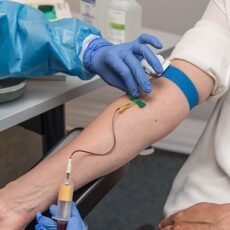
They drew my blood and took another ultrasound – that showed nothing.

Richard and I walked out exhausted. We weren’t expecting any good news, however, going through the motions and living the bad news was painful.

Was I Pregnant or Showing Signs of a Ruptured Ectopic Pregnancy?

Coming home I felt closure. I sat down at my laptop and started to begin putting my life back on track. I called about a job interview, replied to some emails and made a phone call.

Later my cell rang, as it rang I remembered that the doctor offered to call personally to tell me what my new Human chorionic gonadotropin (hCG) values were.

I picked up the phone hoping that he would say that my values were going down as expected, which would mean we could get back to trying soon. He said nothing of the kind.

He took a long pause before telling me that my hCG values had doubled – exactly what they do for a healthy pregnancy! “What does this mean?” cried my brain.

What Does it Mean?

Since the values already went down it couldn’t possibly be a viable pregnancy. Could it?

After firing a few questions at him it became clear that he could not explain what was going on. It was strange: simply strange.

“I don’t want to make you hopeful, but we should not give up yet,” the words he uttered rang in my ear. Not listening, I missed the first part of what he began to say to me. I was in another world. Is this reality?

As I tuned back in and heard him go on to explain that it could be an ectopic pregnancy, it could be an unusual miscarriage, but it has the potential (tiny, but existent) of a viable pregnancy.

As soon as I got off the phone I jumped on the Internet. What does this mean? I typed in rising and falling HCG values. Hit after hit: ectopic pregnancy.

Just sit and wait to see if something happens. This was the advice I had received. What if my tube explodes before anything is done? It was clear I wanted a second opinion… now!

Hanging Onto a Tiny Bit of Hope

Richard called me on his way home and I told him the news that it could be an ectopic pregnancy.

We analyzed while he drove home and when he walked in the door we decided to call his sister, who is a surgeon. Shortly thereafter she gave us the phone number of a very good OB-GYN (a doctor who specializes in pregnancy and female reproductive health).

He reassured us that there was no immediate danger if I was not in pain. “Your values are strange, however, there is a tiny possibility that it could be a viable pregnancy. I have seen so many strange values that have gone on to be health pregnancies”.

“No!”, a voice inside my head screamed you can’t go through this again. I can’t cling to a needle in a haystack probability. Too late. My heart is known for not listening to reason. I lost it. I went to the other side. The side of hope.

Richard’s sister then made an appointment for us at a very well equipped prenatal center that would do an advanced ultrasound to see if they could find the pregnancy. This would be tomorrow.

An Ultrasound to See if I Had an Ectopic Pregnancy

Signs of a Ruptured Ectopic PregnancyI woke up in a light mood. Richard sang all morning. Against our will, hope had crept back in. We worked out, had a late breakfast and went to the prenatal center. Neither of us was directly stressed.

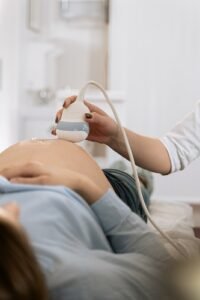
We went into the room and immediately noticed the projector and high quality ultrasound. I lay comfortably down on the bed and watched the ultrasound projected on the wall in front of me. The doctor seemed nervous.

Uterus

She checked the uterus moving the wand inside my vagina to the left and right, up and down. Nothing. No visible pregnancy.

She then measured with Doppler my pulse in the area. We heard my pulse loud and clear. I couldn’t help but imagine that that was my baby’s heartbeat. Richard confessed afterward to having the same thought.

Ovaries

The search continued to the left and right ovaries. In case there was developing sac in my tubes. The tubes are too small to pick up on the ultrasound but if they are harboring a pregnancy then they could become visible.

We watched the black and white picture in front us. I couldn’t decipher anything.

Then doctor called in another doctor. My stomach sank. Is this good? Why does she need another doctor?

When he came in Richard and I were out of the loop. They whispered back and forth. We eavesdropped. Then I heard that they found a cyst on my left ovary. This seemed to be of concern. But it was not a pregnancy, or could not be determined to be one as of yet.

Still a Glimmer of Hope

Time to go home. Fancy equipment. Qualified people. No new information. It was time again to wait. The only factor that can shed light on the situation is my HCG value. The test is tomorrow. This is when we will know more.

If you enjoyed reading my blog, please write a comment here or bookmark it to a social bookmarking site by using the link below. Thanks!

Probiotics and Fertility Diet Part 2

Probiotics and Fertility Diet Part 2

If you haven’t read part 1 of this blog yet, you might want to start there (it covers the basics and the potential connection to fertility): Probiotics and Fertility Diet Part 1.

Otherwise more on those critters in our gut…

Probiotics and Fertility- An Unbalanced Vaginal Microbiome

Research has found a connection between the microbiome and fertility and how probiotics improve fertility. The abnormal vaginal microbiota has been found to negatively impact the birth rate.

Studies

Probiotics and Fertility DietA Danish study of 130 women undergoing in vitro fertilization (IVF), researchers found that those who had abnormal vaginal microbiota had a harder time getting pregnant.

Of the 84 patients who completed IVF treatment, 29 were able to get pregnant. Only 9% of those who had abnormal vaginal microbiota obtained a clinical pregnancy, whilst 44% of the women with normal microbiota bacteria were able to get pregnant.

A Philadelphian study of 1,950 women found that a diagnosis of a common infection (bacterial vaginosis) in the first trimester more than doubled the risk of spontaneous pregnancy loss in the next trimester. It also found that the low levels of the Lactobacillus bacteria in the first trimester also significantly increased the risk of pregnancy loss.

A BJOG Publication Study with over 700 pregnant women, found that those with abnormal vaginal flora – specifically those lacking lactobacilli bacteria – were 75% more likely to have a preterm birth. Also, the risk of miscarriage was significantly increased.

Create a Healthy Digestive System with Probiotic Bacteria

The importance of probiotic bacteria in our bodies is uncontested, but how, and to what extent, we can influence this delicate balance is still being researched.

The research results are very encouraging though. Many experts recommend we ‘cultivate the garden within’ for a healthy body by adopting the right diet, reducing stress, avoiding antibiotics whenever possible, and in some cases supplementing with probiotics and prebiotics.

Foods that Contain Probiotic Bacteria and Prebiotics

We may be able to influence the balance of bacteria in our bodies with food in two ways: by eating foods that contain the good bacteria and by eating the types of food that good bacteria feed off of (prebiotics).

Choose Carefully: not all traditionally fermented foods contain these helpful bacteria. Industrialization of fermentation has lead to efficiency in production and more consistent tasting products, however, it ruins some of the healthful benefits by killing the probiotic bacteria. Pasteurizing, for example, effectively kills all the healthful bacteria.

Foods that naturally contain probiotic bacteria are cultured/fermented foods.

Foods with Probiotic Bacteria

  • Raw Sauerkraut
  • Kimchi
  • Cottage cheese
  • Kefir
  • Yogurt
  • Tofu
  • Miso
  • Tamari sauce
  • Soy sauce
  • Tempeh
  • Pickles (made with brine not vinegar)
  • Pickled ginger
  • Beer
  • Wine
  • Vinegar

Interestingly, cultured foods have long been recognized as an integral part of a healthy diet like Miso in Japan, Lassi drinks in India, Kimchi in Asia and sauerkraut in Europe – just to name a few.

The second way to boost probiotic bacteria is to eat foods that provide prebiotics. Two well documented prebiotics are FOS and inulin, which are naturally occurring carbohydrates found in the following foods.

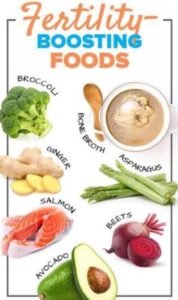
Fertility Boosting FoodsFoods that Contain Prebiotics

  • Asparagus
  • Chicory
  • Chinese chive
  • Burdock root
  • Eggplant
  • Fruit (especially bananas)
  • Garlic
  • Jerusalem artichokes
  • Leeks
  • Legumes
  • Onions
  • Peas
  • Soybeans
  • Sugar maple
  • Tomatoes

Probiotic Supplements

Probiotic supplements are high doses of specific strains of beneficial bacteria in an easy to take form (liquid, power, or capsule). Initial studies are encouraging and suggest that probiotic supplements can be used to treat various health issues.

Numerous doctors, naturopaths and nutritionists recommend probiotics for this reason, however, the extent of the claims being made has not yet been rigorously proven through research.

Elizabeth Lipski, author of Digestive Wellness, recommends that already healthy people can maintain their healthy bacteria by eating cultured foods, but says supplements are necessary when disease producing microbes have colonized.

Dr. Haas makes a similar recommendation in his book, Staying Healthy with Nutrition, by recommending probiotics for use after a course of antibiotics or to treat yeast overgrowth, otherwise, he says, “I recommend them for one to two weeks once or twice a year…”.

It’s important to note that probiotics do not all have the same quality.

Some guidelines for choosing probiotics are:

  • Probiotics requiring refrigeration at the store and at home tend to be the best
  • Accompanying probiotics with prebiotics may be more effective since this provides food for the bacteria once they they enter your digestive system
  • Probiotics that include several strains are helpful

Elizabeth Lipski also emphasizes in her book, Digestive Wellness the following tips:

  • Different combinations will work for different people and to a greater or lesser effect.
  • You’ll have to experiment with different brands and see which are most helpful.
  • Remember to begin with a small dosage and increase slowly. You are changing your gut ecology and you want to do it gradually.

Another important aspect to taking probiotics that Elizabeth Lipski points out is that it’s not necessarily a bad sign if the supplements cause a sudden bloating, diarrhea, gas, or worsening of symptoms. She explains that, as the bad bacteria and fungus die, they release chemicals that aggravate symptoms. If this happens, she recommends beginning again and building up slowly.

Naturopath Linda Page suggests that probiotic supplements are not for everyone because each person’s digestive system is highly individual. She recommends getting probiotic bacteria from food and by supplementing with prebiotics.

The good side to this new dietary supplement is that probiotics have no toxic effects and the American Cancer Society addresses the safety of one of the more popular probiotics strains, Lactobacillus acidophilus, by stating that; except in rare cases acidophilus is safe.

Probiotics and Fertility Conclusion

Although, I haven’t covered them in detail here prebiotics are also available in supplemental form.

For my next blog I’ll be writing about how I’m getting probiotics and prebiotics, how my body likes/dislikes them along with a list of some helpful resources. Until then, happy bacteria consumption.

My Fertility Plan Revisited

My Fertility Plan Revisited

This is not how either my husband or I really wanted to spend our Monday night – settling into an oversized movie chair for Ron Howard’s new movie, Frost/Nixon, sounded way better. But we both know the benefits of making and then reviewing a my fertility plan.

“We need to talk tonight.”

“About what?”

“Reviewing our fertility plan.”

Silence. A sigh. “Yes, let’s do that.”

My First Fertility Plan

Last September my husband and I created our initial fertility plan whilst on the top of a mountain.

So we settled into our usual planning area, a couple of cushions on the living room floor, and looked at the plan we drew up last year sometime after my miscarriage.

my fertility planThe old fertility planning looked like this:

    1. Repeat liver cleanse and gallbladder flush
    2. Research and implement the best fertility diet
    3. Begin daily weight lifting
    4. Go back for fertility mud baths
    5. Go to Sharkey’s Healing Center for herbal treatment
    6. Head to the infertility clinic

I did steps one through four. So why not move on to step five? Because three things happened:

  • I learned that it usually takes between three to eight months for natural fertility treatments to heal the reproductive system
  • My body has been transformed beyond my expectations by my fertility diet: my acne disappeared, my digestive system became regular and my energy returned.
  • My cycles went from 44 to 39, then to 36 days.

It seems like I am on to something – something that is making me healthier and more fertile!

When Should We Revive My Fertility Plan?

Revising my fertility plan to give the fertility diet the time it needs to heal my body seems like the smartest thing we can do. But how long should we allow it to run before doing a revision? Should we wait the full eight months?

Surprisingly, this was relatively easy to decide.

We talked about it for all of about ten minutes and decided that I’ll do the fertility diet for three more months by itself. Following that I will add three complementary treatments that I did before I had my positive pregnancy test last year:

We’ll give the fertility diet and these complementary treatments the full eight months to heal my body – before moving on to herbs and then conventional medicine.

Eight months. Yes, this sounds very long to me!

Fertility Declines After 32

I’m almost 32 years old – just three years away from the age many studies suggest fertility begins declining for most women, so it’s hard to give these treatments eight full months. However, nothing I’ve tried has had such a positive effect on addressing the source of my problems and healing my body, than the fertility diet.

I’ve been following the ideal fertility diet for a couple months now, but we’re going to start counting the eight month period from the beginning of January. The reason for this is that I fell off the fertility diet wagon over the New Years period. I suffered the consequences and had to start over in bringing my body back into balance.

It was my husband’s idea to follow the fertility diet for three months before adding the complementary treatments. His idea has merit for these reasons:

  • Three months is generally the time it takes for the body to recover: It’s the time, for example, that conventional medicine often stipulates is needed to fully recover from surgery and it’s the time natural fertility experts often recommend as a minimum for treatment to take effect. So, since the fertility diet is healing my body, we’re giving it three full three months to do so, solo, in the hopes that it fixes a few of my other lingering problems: breakthrough bleeding, my short luteal phase and my still too long cycles.
  • Also, we’re moving and three months is about the time we need to settle into our new place. Seemingly unrelated to fertility, moving and implementing other fertility treatments would be counterproductive since squeezing them into our schedule is likely to add a good deal of stress.

My Fertility Plan Now Updated

So, the new fertility planning looks like this:

    1. Continue following fertility diet
    2. In about three months go for 3 weeks of Mayan abdominal massages
    3. After the massages begin 2 weeks of fertility mud baths
    4. After the baths begin castor oil packs for two cycles
    5. In August 2009 go to Sharkey’s Healing Center for herbal treatment
    6. After three months of herbal treatment head to the infertility clinic

This looks like a plan. A done deal. But not so fast. Our fertility planning didn’t go quite that smoothly. At step six we hit a kink – a very big kink.

We agree on the plan and all its details up until “head to the infertility clinic”. Right now we have no solution for, or have the faintest clue how we can solve our very big difference of opinion: we are both open to the infertility clinic up until the point the doctor recommends IVF.

I would consider trying IVF if the natural fertility treatments do not work on their own. My husband is not open to trying IVF – under any circumstances.

Right now we’ve agreed to disagree. We see no solution.

We’ve decided to see how the new plan goes before discussing IVF options. With our initial fertility plan we saw how quickly things can change. I think it’s important that we both know how the other feels and respect each other’s feelings and opinions. We can’t do any more than that right now.

I’m hopeful that we will never have to go down the IVF option.

So, for now, I’m going continue following my fertility diet – one day at a time.

Fertility Liver Detox: You Did What?

Fertility Liver Detox: You Did What?

I’m tired and weak. But then I knew this is how I would feel today after doing a fertility liver detox.

Last night, immediately before bed, I voluntarily drank 1/2 cup olive oil mixed with 3/4 cup grapefruit juice. Disgusting? Not really. Nausea inducing? Absolutely!

So the hundred dollar question: Why? Why would I subject my body to this – twice? (In December of last year and again now.)

All in the name of flushing my gallbladder and cleansing my liver, of course.

Yes, I too think this is a totally crazy and questionable thing to do. But what if it helps me have a baby?

I have yet to come across any direct scientific evidence that this is going to boost my fertility, but – and here is the big but – it might!

Why the Liver is Important to Reproductive Health

Fertility Liver DetoxZita West (a midwife, nutritionist, and acupuncturist specializing in fertility) in her book, Fertility & Conception, spells out just why the liver is so important for reproductive health:

“The hormonal balance needed for fertility depends on good liver function. Your liver detoxifies many substances…It chemically alters excess or used hormones for recirculation.”

Zita recommends cleansing the liver – not like I did last night – but with a 10-day liver detox diet that includes foods that are good for the liver, or those that do not make the liver work hard to digest.

My Fertility Liver Detox

This is something I’ve already tried though. Unfortunately, it did not clear my skin of acne, balance my hormones or make my cycle regular (symptoms potentially related to poor liver function). No, I needed something more.

So, for the past several weeks I’ve been drinking herb tinctures (from sensiblehealth.com) and following a restricted diet.

Then in the week, before the flush, I drank a liter of apple juice spaced between meals throughout the day (as recommended by Andreas Moritz in his book, The Liver and Gallbladder Miracle Cleanse).

Last night came the ‘grand finale’, as Richard called it, when I drank the tasty concoction of olive oil and grapefruit juice.

If you never drank this before, I can tell you that it’s followed by the most overwhelming urge to, well, vomit. And the first time I did this cleanse, I gave in around 2:00 a.m. to this urge – my wood floor still reminds me of this!

This time, though, I was awake half the night with nausea, but was able keep the contents of my stomach from reappearing.

Gall Bladder Flush

In the morning, I got up and drank Epsom salts – and here is where the results are supposed to be apparent! You succeeded in flushing your gallbladder when you actually pass gallbladder stones.

Now this is a totally controversial topic because there seems to be no scientific evidence to say that the pebbles that come out, are really gallbladder stones, nor have I found evidence that this really cleanses the liver.

However, what I did find is that there is no indication that this is harmful to your health. Even those sources that feel the cleanse is not effective believe the worst case scenario is nausea.

So, I was hoping that I would pass stones like the ones pictured in Andreas Moritz’s book, or be able to write an infertility testimonial like the ones on sensiblehealth.com.

But there were no stones to be seen. And, yes, I checked thoroughly (except for when I went to the bathroom once in the middle of the night: I was too nauseas to look very long so I just gave it a quick once over).

I also can’t say that I feel any different or notice any observable health improvement.

Will I Do Another Fertility Liver Detox Again?

So well, that’s it. Can’t imagine doing a fertility liver detox again – but, then again, I said that last time didn’t I? Really though, I’m done. I suppose the effects could still surface, like if my cycle were regular this month or my acne cleared up. But since I’ll be moving on to other treatments it would be tough to truly attribute anything to this treatment.

For me, the liver cleanse is what I consider a wildcard. It’s a treatment that has not been scientifically proven or disproven. And since I didn’t feel it endangered my health, I was willing to try it.

Maybe it works for other people. Maybe one day it will come under scientific scrutiny, but until then, I’m done with it. For me, it seems to have been a dead end. I’m heading back into the realm of more founded methods. I’m turning my attention back now to a nutrition plan, a fertility diet.

If you enjoyed reading my fertility blog, please write a comment here or bookmark it to a social bookmarking site by using the link below. Thanks!

Men Asking Labor and Delivery Questions of the OB-GYN

Men Asking Labor and Delivery Questions of the OB-GYN

There are a multitude of different places where people can get bogged down, or concerned, during the pregnancy process with possible unexpected events. A woman going through pregnancy needs the full support of her partner in the process. A man asking labor and delivery questions of the OB-GYN, not only keeps him in tune with what is to be expected, but his interest in the pregnancy, labor and delivery process provides comforting support for his partner

Asking Labor and Delivery Questions

It is usual to have as many as ten appointments with the OB-GYN during pregnancy. During these appointments, the doctor will do the usual checks and explain what to expect.

It is important for the man to attend as many appointments as he can. By doing so he will also know the process and she will be appreciative that he shares the responsibility of understanding the details of birthing.

Asking Labor and Delivery QuestionsAt some point the doctor will ask, “Any questions?”

Use this as an opportunity to find out more, preparing both man and partner for labor and delivery. For the man, it is the perfect time to get involved. By doing the asking, he takes on a shared responsibility, which will prove to be helpful when the time comes for the baby to arrive.

The doctor will give lots of information. It is important for the man to commit what he learns to memory and reassure his partner that he understands the process and knows what will be done when the baby is ready to be delivered regardless of whether the doctor is present or not.

Labor and Delivery Questions to Ask

Time to go to the hospital

  • How will we know that our baby is coming?
  • How will we know that labor pains have begun?
  • What should we do if her water breaks or there is a bloody discharge from vagina?
  • What if she doesn’t get labor pains?
  • What should we watch for in the case of an emergency?

Labor

  • What pain can she expect?
  • What can we do to help minimize pain?
  • What are the options for pain relief?
  • What is an epidural? What are the risks?
  • Can she eat or drink?
  • How much time will it take to deliver once labor pains have begun?
  • What happens if you are not available for the delivery?
  • What are our chances of a normal delivery?
  • Who can come in the labor room?

Stay in Hospital

  • How many days will my partner need to stay in hospital?
  • Can someone from our family stay with her in the hospital?
  • What kind of clothes will she need?
  • What do we need to bring for the baby?
  • Is cord blood storage an option?
  • How long will our baby need to stay in the hospital?
  • When should breast feeding begin?
  • What if she doesn’t produce enough milk?
  • Do I need to bring a car seat?

Complications

  • If there are complications, will we be transferred to another hospital?
  • Are there any factors surrounding her pregnancy and general health that could impact the birth?

What if Your Usual Doctor is Not There For The Delivery?

One of the scariest moments for a woman during pregnancy is when she realizes that her doctor is not on call and will not be delivering her baby.

This can be emotionally shattering for the woman, but men must remain composed and remind their partners of the process that is in place.

The truth for most deliveries is that the doctor is frequently not even in the room for a good majority of the labor (and sometimes even the delivery).

Nurses will be attending to the birth. Likely you will not know them. Understanding the process explained by the doctor and the needs of the mom, will ensure everyone stays calm.

The man can explain to his partner that this is important to him as well and that he has prepared for this situation.  He can take charge and talk to the nurses about what his partner needs, make the process as easy as possible.


Pregnancy, and bringing into this world a baby, is a very special time for all. A man fully immersed in the process and supporting his partner, will build a strong bond for the whole family.


Fertility Diet has Taken Hold!

Fertility Diet has Taken Hold!

It’s hard to believe but I’ve been researching, testing and tweaking for over seven months now in order to find the perfect fertility diet- best food to get pregnant.

I’m there.

  • I have my energy back
  • My digestive system is regular and healthy
  • My acne has completely disappeared
  • I have no more muscle cramps

In short – I feel great!

food to get pregnantThere have been setbacks and long periods of waiting while my system adjusted to the food to get pregnant, but I’ve reached the point where my body is telling me, “Yes!”

Gluten Free

It hasn’t been easy though. Just four weeks ago I was feeling so bad that I went in to see my doctor to make sure there weren’t any serious health issues. He found none and even tested me for gluten intolerance, which came out negative. This wasn’t surprising since the test has to be conducted while on a diet that includes gluten – mine at the time was virtually gluten free.

I listened to my body though, and stepped my diet up to 100% gluten free. This is one of the best decisions I’ve made so far. After following it for three weeks, the bleeding during bowel movements disappeared, my acne cleared up and my muscle cramps disappeared.

Gluten was the last step in my fertility diet but quite possibly the most important one for me.

I still have a big question: What affect is this diet going to have on my long, irregular menstrual cycles- ill they become regular?

I’ll have to wait another few months to see a trend, but given the way my overall health is improving I’m very optimistic. We’ll see how it goes.

If you enjoyed reading my fertility blog, please write a comment here or bookmark it to a social bookmarking site by using the link below. Thanks!

Added notes:

Does gluten-free diet increase fertility?

If you have Coeliac Disease, then removing gluten from your diet will improve fertility. If you are not a Coeliac, there is no scientific evidence to support that a gluten free diet will improve your chance of getting pregnant. 

Food to Get Pregnant

  • Full fat dairy
  • Good fats (unprocessed- like coconut oil)
  • Legumes
  • Sweet potato
  • Berries
  • Eggs
  • Dark leafy greens
  • Quality meats
  • Avocados
  • Fish
  • Omega 3’s (non-animal sourced)
  • Whole grains
  • Nuts and seeds

How Fast Can It Take to Get Pregnant?

How Fast Can It Take to Get Pregnant?

How fast can it take to get pregnant? I’ve asked myself this question so many times. And I know I’m not the only one.

Fast is relative, so let’s look at the two main options to facilitate conception (a.k.a. hurry up and get pregnant): natural treatments and conventional medicine.

How Fast Can It Take to Get Pregnant with Conventional Medicine?

Originally, I thought that conventional medicine would offer the fastest way to get pregnant. But as advanced as many of the conventional fertility treatments are, I discovered that they are not the speeding bullet that I had once hoped.

It took me almost a year to find the right fertility clinic, get an appointment, go through the initial battery of tests, and execute the first treatment. Not to mention that the first treatment is just that: the first treatment.

To my knowledge there aren’t any statistics available on how long the treatment of infertility through conventional medicine usually takes until (if) it’s successful. And since treatment length seems to vary greatly between individuals, we still wouldn’t know how long it’s going to take each of us (where’s that crystal ball when you need it?).

How Fast Can It Take to Get Pregnant Naturally?

How fast can it take to get pregnantWomen have shown that we can increase our odds of having a baby through natural treatments, but the catch here is that in order to boost our fertility naturally we need time.

Before we all hit the panic button, remember that natural remedies for fertility generally focus on bringing the entire body back into balance.

This, for me, is gaining time. Why? Because bringing our body back into balance not only increases our chances of having a healthy baby, but can actually prolong our fertile years (as Julia Indichova describes in her book, Inconceivable).

It has taken me about four months to find the right fertility diet for my body. Once I found it, my body showed positive signs of health starting after just one week (like the disappearance of acne and a regular digestive system). And now I’m seeing a trend in my cycles: they are becoming shorter  –  a more normal length  –  having gone from 44 to 39 to 36 days.

A good trend. But can you wait out three cycles? That’s a long time for those of us in a race with our biological clocks.

But that’s the reality of it; it may take several months to bring the body into balance through natural methods.

There, I said it. What none of us wanted to hear: It takes time to boost your fertility naturally.

We all want to run away from the fact that there is no quick-fix. However, if you’ve made it this far in the article (even though I don’t have a magic supplement, a miracle pill, or a stand on your head trick to share) you’ll probably want to stay for the good news  –  I promise it’s coming.

Why Does Increasing Fertility Naturally Take Time?

When we think of getting pregnant, we most often think that each cycle is a fresh start: an egg develops and releases. We’re born with about 350,000 follicles. Each needs longer than one cycle to develop into an egg. In fact, the entire growth phase of a follicle is longer than 220 days or eight menstrual cycles.

Hormones

During those 220 days, the follicles go through various stages, and although scientists don’t know all the hormones responsible for the health and development during each stage, they do know that the hormone ‘Follicle Stimulating Hormone’ (FSH) is vital in the later stages and I believe it plays a role in the earlier ones as well.

Natural fertility treatments, like diet and exercise, can create healthy levels of FSH, and therefore healthy eggs. How? Through insulin – the hormone your body uses to regulate sugar. If insulin levels are high (often a result of eating poorly or not exercising) the amount of free insulin-like growth factor increases, which inhibits the function of FSH.

Knowing this, it’s not hard to imagine that a healthy growth phase (220 days) requires a healthy, balanced body.

Natural Pregnancy Risk Free and Painless

Dr. Jeremy Groll, an expert in reproductive endocrinology and fertility treatment, has experienced this with many of his patients. In his book, Fertility Foods, Dr. Groll says, ‘I am not selling a get-pregnant quick scheme, but I am offering a solution to your infertility that’s risk-free and painless.’

He goes on to say that ‘the diet and exercise program may work in just a month or two, but that several months may be required to get your insulin levels in check and your body responding properly’.

Herbalist, Stacey Roberts from Sharkey’s Healing Center, also reports that her patients need about 6-8 months to balance out their bodies and become pregnant.  Interestingly, her patients that use the herbs and supplements prior to undergoing IVF, to increase there chances of success, reported producing healthier eggs.

Having a Healthy Baby!

Getting your body healthy and into balance prior to pregnancy also increases your chances of having a healthy baby: after all our desire is to have a healthy baby – not just get pregnant.

There’s a long list of proof that a healthy body has better chances of giving birth to a healthy baby. Like a mother who gets enough folate prior to conception has a reduced chance of having a child with neural tube defects and a mother with healthy insulin levels has a lower chance of miscarriage.

How Fast Can It Take to Get Pregnant?

So, for those with clear cut infertility issues that can be addressed directly with conventional medicine going to an infertility specialist could be the fastest way to get pregnant. However, for those of us with unexplained infertility, or an issue that has no effective treatment, natural treatments could be our fast track to getting pregnant and to having a healthy baby.


Pregnancy After 30 – Weighing the Risks

Pregnancy After 30 – Weighing the Risks

In this modern age, many women now choose to wait to have children until after 30. This choice comes with women having more independence than ever before. Sometimes the choice to wait is based on establishing a career and being financially sound first, other times it can be due to not finding the right partner or other reasons that are unique to this day and age. Whatever the case, pregnancy after 30 comes with its challenges.

We are past the point when girls were expected to grow up, get married, have a family and stop at that.

Pregnancy After 30 Risk Factors

Although the benefits of this new age of choice are many, with it also comes plenty of risk factors. Child birth over the age of 30 has the risk of increased complications, and is considered to be a high risk pregnancy.

Rush University Medical Center states chromosomal abnormalities such as Down Syndrome to be one of the biggest risks, with chances of having a Down Syndrome baby jumping from 1 in 1,100 when a mother is between ages 25 and 29, to 1 in 350 when she is 35.

Pregnancy After 30Largely attributed to this increase in chromosomal abnormalities is also the occurrence of more miscarriages in this age group than with younger women.

According to Health & Lifestyle Magazine, other potential health issue for women associated getting pregnant in their 30s, include heart disease, high blood pressure, and kidney problems.

Diabetes is also commonly associated with this type of pregnancy, as well as an increased risk of breast cancer later in life. Although, Womenshealth.gov says that breastfeeding will help to decrease the threat of breast cancer.

Proper prenatal care is a highly important aspect to the safety of mother and child with any pregnancy, but especially so in the instance of a pregnancy over age 30.

It Isn’t All Doom and Gloom

In any case, women are still making the choice to have children after age 30, and many of these mothers and their children are still healthy and happy. Well-known women have taken the stage in becoming mothers later in life, and everyday women have become celebrities in doing so.

The good news is that when a baby is born in a state of normal health, it is unlikely to have any more complications than a child of a younger woman.

Many women are saying that a settled lifestyle that comes with age is more conducive to raising a family at this time than in younger years.

Other Possible Benefits of Having a Baby Later in Life

  • Boost your brain power
  • The child may have a reduced risk of injury
  • Parents may be more prepared emotionally
  • The child is likely to be more tech-savvy and better educated
  • Parents may be more financially stable
  • Parents may live even longer

What Can Women Do to Increase Pregnancy After 30?

  • Aim for a healthy weight – speak with their doctor or nurse to understand what is a healthy weight range
  • Eat a healthy, balanced diet
  • Take folate and iodine supplements as directed by a doctor
  • Do regular, moderate exercise
  • Relax- do yoga, meditate
  • Avoid alcohol, drugs and smoking